

Blog Post
Publish date: January 28, 2026 | Reading time: 15 minutes

Before we talk about what’s changed, let’s talk about why paid search has always mattered. In a word, control. No matter how efficient brands have been at SEO strategy and management (both important), they could only influence, but not “control,” where they ranked in organic search. Paid search was the answer to that uncertainty, and for a price, Google has always been happy to have your ad copy and call-to-action pop up right at the top of search results.
That said, we love organic search. For the better part of two decades, and despite Google’s frequent algorithm changes, most company websites in B2B verticals have seen most of their site traffic come from organic search results. So rightfully, we’ve invested in capturing and maximizing that organic traffic. So, what’s changed? Two factors are making it trickier to rely on organic search.
1. Organic Discovery Is Less Predictable Than It Used to Be – AI-generated summaries and other enhanced search results now appear on a growing share of search results pages, especially for informational queries. As these features expand, organic click-through rates have declined even when keyword rankings remain strong. This means that while organic will continue to be a powerful source of traffic, your visibility is less likely to result in a click-through.
While precise zero-click rates for industrial B2B searches are not publicly segmented (yet), the overall pattern is clear. Organic visibility is increasingly shared with ads, AI summaries, and other Google-owned features, making traffic less predictable.
2. AI Absorbs Early Informational Queries – AI tools are increasingly playing a role in explaining concepts and summarizing options for searchers. This is changing how early-stage learning happens.
Industrial buyers are still demanding customers who need to confirm specifications, verify certifications, review documentation, and assess supplier credibility. This opens the door for paid search at the critical point when basic online vetting turns into lower-funnel evaluation.
Before you start writing ads, it helps to understand how the Google Ads system is set up. A simple way to think about Google Ads is as a set of nested folders.
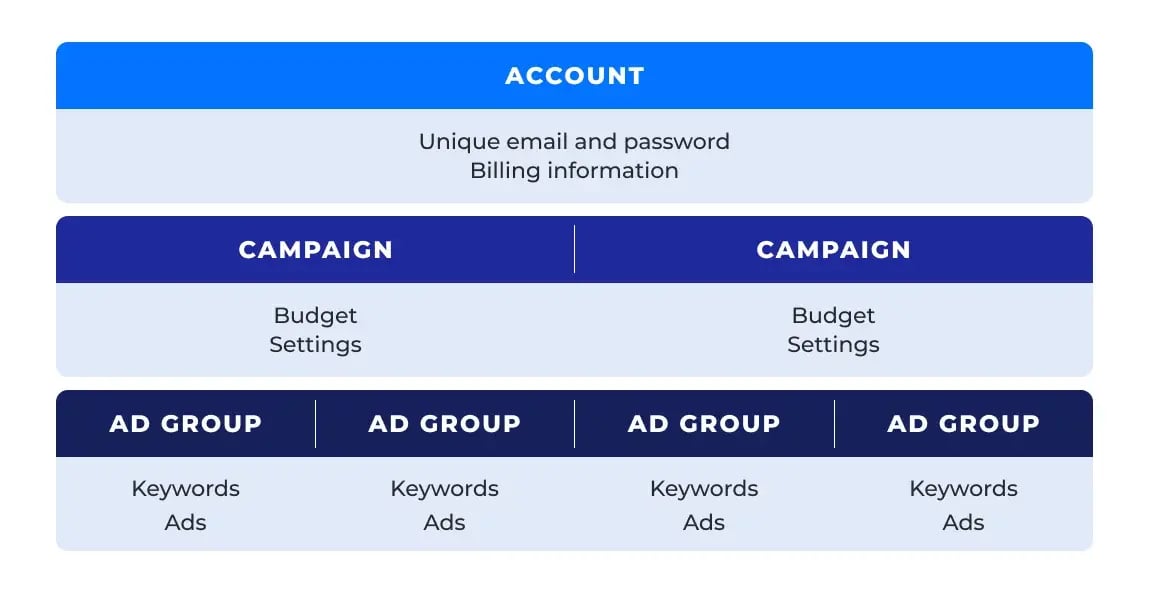
When someone runs a search, Google looks at different signals to decide which ads to show. These include the words in the search, the account structure, and how closely the ad copy aligns with the assumed intent behind the search.
At the core, the most important thing to understand is that Google rewards relevance. Ads that clearly match what someone is looking for tend to perform better than ads that are generic or broadly promotional.
Negative keywords also play an important role. They help prevent ads from showing up in searches that are driving traffic but not really relevant to your products. This is especially important in industrial markets, where consumer, DIY, or academic searches can look similar on the surface.
Assuming we agree that paid Google search ads are an important part of the mix, let’s look at which ones are available and dissect them.
When people talk about Google paid search ads, they are usually referring to ads that appear directly on Google search results pages. There are two primary paid search ad formats you should be aware of.
1. Responsive Search Ads – Responsive Search Ads (RSAs) are the most common and flexible type of text-based, paid search ad. Instead of writing one fixed ad, you give Google the different ad components, and then Google assembles and tests different combinations based on search queries and user context.
Responsive Search Ads typically drive traffic to a landing page and are used for:
Product and application searches
Specification and certification queries
Brand and model lookups
The interesting part of responsive search ads is how Google uses machine learning to dynamically assemble, serve, and test ads made from the aforementioned parts and pieces. For RSAs, you’ll need to provide:
Headlines: Up to 15 headlines, each with a maximum of 30 characters
Descriptions: Up to 4 descriptions, each allowing a maximum of 90 characters
Asset: For example, a landing page URL
2. Call Ads – Call Ads are also paid search ads, but they’re designed for situations where a phone call (click-to-call) is the primary conversion action. Instead of clicking through to a website, users are encouraged to call your business directly from the search results page.
Common use cases for Call Ads can include:
Buyers need immediate technical support
Sales conversations are the main conversion goal
Products or services require live qualification
Call ads are structured like this:
Headlines: Up to 2, each with a maximum of 30 characters
Descriptions: Up to 2, each allowing a maximum of 90 characters
Business name: Up to 25 characters
Display path: Up to 15 characters
Asset: The actual phone number is entered separately as an asset
Now that we know what we have to provide for paid search, we need to write that ad copy. This will benefit from a quick look at how industrial prospects search the web today. If you work in manufacturing, engineering, or industrial services, you probably already know that industrial search behavior looks nothing like consumer search behavior. Industrial buyers are rarely browsing. They do not search for fun. They search because they need to solve a problem, meet a requirement, or complete a project. That means their queries often include really specific details that tell you exactly what they want. Understanding these patterns helps you write ads that feel immediately relevant.
1. Spec-driven searches – This type of search includes the exact details of the product buyer's needs. These users usually know what they need and are comparing suppliers or verifying technical fit. If your ad repeats or reflects the key specification, the buyer knows immediately that you belong on their shortlist. Many beginners make the mistake of writing ads with generic messages like dependable performance. A buyer searching for an ATEX motor doesn’t initially focus on dependable performance. They care whether the product is ATEX certified. This is why matching the specification matters.
2. Problem-based searches – Sometimes buyers don’t know the product name. Instead, they describe the problem. These queries appear earlier in the buying journey, but they’re still valuable. If your ad acknowledges the problem and offers a path to a solution, users will see you as a helpful resource.
3. Conversational AI influenced searches – More searches today look like full, conversational questions because people are used to “talking” to AI tools. Even though these queries sound different, they still contain intent. Your ad should not repeat the full question; it should answer the essence of it.
4. Brand/model searches – This search approach happens later in the evaluation process and helps the prospect drill down. These users already know you or your competitors. They want documentation, pricing, compatibility details, and alternatives. Your ads should make those easy to access.
When you’re thinking about your paid search strategy, it’s important to remember that AI-generated summaries and answer boxes sometimes satisfy early-stage search questions. This has reduced organic traffic in many industrial B2B business verticals. But mid- and late-stage searches still rely significantly on clicking through to learn more. That’s not necessarily bad news, as lower funnel paid clicks are closer to the purchase decision, where you need to be front-and-center. For you, that means writing more mid and late funnel paid ads that are specific enough to stand out from generalized AI summaries. The more your ad feels like it understands the user’s technical context, the more likely it is to earn the click.
Writing paid search ads is not about persuasion in the traditional advertising sense. It’s about clarity. A good search ad quickly confirms three things for the person reading it:
1. This ad is relevant to what I searched for
2. This company understands what I need
3. There’s a clear next step
Google search ads are delivered primarily through RSAs. Instead of writing one fixed ad, you should write multiple headlines and descriptions. Google then tests different combinations to see which ones work best for different searches. Your job is to provide clear, useful building blocks. Google handles the assembly.
Headlines are the most important part of a search ad. They’re the most visible element and do most of the work in confirming relevance. Good headlines tend to do one of a few specific jobs.
Some headlines confirm fit or scope. They help the reader immediately understand whether the ad applies to their situation.
Other headlines establish credibility. This might include experience, certifications, or areas of specialization.
Some headlines acknowledge a problem or need and suggest that a solution exists.
Some headlines guide the next step, such as requesting information or learning more.
A strong set of headlines usually includes a mix of these roles. What matters most is that each headline says something meaningful on its own. It’s also important to make sure that as you write strong headlines, you don’t forget to write within Google’s rules and best practices.
One question we hear is about where the brand name belongs in a strong headline. The surprising answer is that in most cases it does not need to be there at all. For search in industrial and manufacturing, headlines tend to perform best when they focus on relevance to the search intent (e.g. products with certain certifications, or tolerances).
With only 30 characters available in your headline, every character has to work hard to earn its place and deliver relevance. The important exception is that is makes sense to include the brand in late-stage or branded search ads where the product name is more likely to attract a click. Otherwise, a common practice is to place your brand name into the description where character limits are a little more forgiving and your brand name can reinforce credibility or relevance to your prospects search.
After your headline, you need a description. Fitting within a 90-character limit, descriptions support the headline by adding context and reducing uncertainty. They help the reader decide whether clicking is worth their time. Effective descriptions will:
Descriptions don’t need to be long or clever. Clear, plain language works well, especially for technical or industrial audiences. Just like headlines, you have a number of versions (4) that you can include with a responsive search ad. Writing all four descriptions will help you maximize the ad's effectiveness.
B2B buyers in industrial/manufacturing often evaluate risk as much as capability, so including a limited amount of technical detail can help qualified readers self-identify and engage with confidence. This does not mean listing every specification. One or two important, relevant details are usually enough to signal your seriousness and competence.
Earlier, we talked about how AI changes search behavior and how more searches now appear as full questions rather than short phrases. Here is what that means for how you write an ad. When writing for these kinds of searches, it’s not necessary to repeat the question. Instead, focus on the underlying need. Clear, direct headlines that address the need tend to perform better than ads that try to mirror conversational phrasing exactly.
Even well-written ads don’t exist in a vacuum. A few surrounding factors strongly influence whether good copy performs well. Ads tend to work better when the landing page you send users to clearly matches the ad’s promise. This means when you get to the page, the next step is obvious and appropriate for the buyer’s expectations.
Keywords – Often overlooked, this step is making sure the keywords in your ads are also present on your landing page. By ensuring this, you’ll improve both the landing page’s relevance with your prospect as well as improve how favorably Google looks at your ad (remember, they care about relevance too).
Utility – Once you’re consistent with keywords, you’ll also want to make sure your landing page offers utility. Buyers in manufacturing and similar B2B spaces respond to practical value. Resources like technical documentation, tools that help narrow options, or access to FAQs and knowledgeable representatives improve performance.
Scanning – Writing for prospect scanning behavior also matters. By using familiar terms, simple sentence structure, and clear phrasing in your copy, you’ll improve user retention and engagement once prospects click your ad.
Once your ads are clear, relevant, and accurate, other elements such as conversion tracking, automation, and reporting help improve performance over time. These topics matter, but they sit outside the scope of writing ads.
If you’re new to paid search, it’s worth focusing first on getting the fundamentals right. Clear structure and clear copy are the foundation everything else builds on.
Paid search advertising remains one of the most dependable ways to reach industrial and manufacturing buyers who are actively researching solutions and suppliers. Even as search behavior changes and AI tools influence how people ask questions, fundamentals like relevance, clarity, and usefulness still apply. When your ads speak the language of your buyers and you offer them useful resources, you build a strong foundation for success and generate high-quality leads.


enews
Sign up for Godfrey enews to get B2B marketing agency insights, industry trends and valuable resources delivered directly to you.


