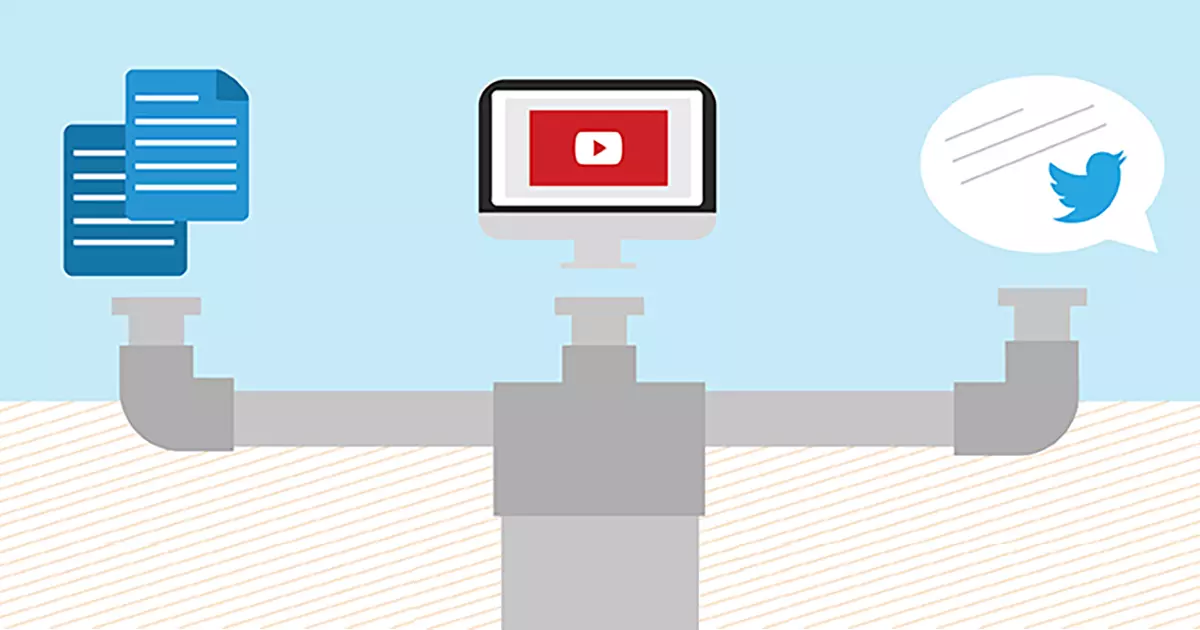
Recent posts by Stacy Whisel and Jim Everhart provide good reasons WHY B2B marketers should consider adding social media to their marketing communications programs.
As we engage marketing people about B2B social media, the conversations usually starts with HOW, whether it's externally (the technologies and channels) or internally (the company policy that governs social media participation).
Both of these are important, but what tends to be a secondary conversation is WHAT should be communicated. Maybe that's assumed, although the "wild frontier" nature of social media brings with it a lack of focus, so we don't like to assume away the need for a solid messaging plan. It's an essential part of brand guardianship in the social media arena.
What's more, there isn't much conversation about how to ensure that core messaging is conveyed in an effective manner. ---More---
In my last two installments on Creating and Maintaining a B2B Blog, I offered suggestions on who should write your company blog, how often you should post and how to develop a content strategy for your blog.
In this third installment of my blogging series, I’d like to make some suggestions on how to promote your blog.
If you are going to invest the time, resources and discipline to create a blog you’ll want to be sure it’s getting read. It is not as simple as, “Build it and they will come.” You’ll need to promote your blog, let people know it exists. Consider all the tactics you can use to announce and then promote your blog including email, your website, search and other blogs. You’ll need to be proactive. Think about active and passive forms of promotion. Here are a few suggestions.
1. Start with your company website. Make sure there is a link to your blog somewhere on your site, or multiple pages if relevant. ---More---
Is it just my imagination or is the Social Media landscape expanding faster than global warming on the Arctic’s polar ice cap?
On the publishing side of Social Media, we’ve got key players such as Wikipedia and Digg.On the sharing front, it’s Web sites like YouTube and Flickr.In the social networking arena, the heavy hitters are Facebook and LinkedIn.And don’t forget Twitter, which has taken blogging – in this case, microblogging – to a whole new level.
At this stage of the game, B2B marketers probably feel like they need a scorecard to keep track of all the Social Media players, their positions, strengths and weaknesses.The question is, which player is paying its dues right now in the minor leagues, poised to make a dramatic leap to the big leagues?
I don’t have that answer, but I do know one thing: Social Media is here to stay.And here’s ---More---
In my last blog on Creating and Maintaining a B2B Blog I offered some suggestions on who should write your company blog and how often you should post. In this installment, I’d like to follow up a bit more on the frequency of posting and give some direction on what you should be posting. The question we are often asked is, “How often should I add new content or post on my company blog?” The simple answer is: When you have something relevant to say. When you post and what you post is related. Let’s assume you’ve identified an internal “expert” or core team of employees with the responsibility of managing to your company blog. You now need to determine the frequency of posting and create a realistic schedule. Let’s start at the top. 1. Think Strategically a. Does your company have a marketing and communications strategy? What you ---More---
As social media continues to make inroads into the B2B universe, more companies are including blogs as a communications tactic. According to the Society for New Communications Research, 16 percent of Fortune 500 companies support a corporate blog while Forrester Research reports the number is closer to 29 percent. Both reports are one to two years old so I suspect the numbers are much higher today.
As acceptance of blogging continues to grow I thought it might be helpful to give some advice on how to create and maintain a company blog. This is the first of several blogs, each focusing on a specific topic.
Let’s start at the beginning. You’ve decided to create a blog but are faced with two important questions: 1. Who should write the blog? 2. How often should you post?
Some companies are fortunate and have an “industry expert” on staff, someone with broad industry ---More---
Chances are your audience won’t be waiting patiently for you to return as the economy flips its frown upside-down. As marketers, we are challenged to reach our audiences where they want us to reach them, not where we think they’ll be. Listening and researching are imperative in order to offer a successful and relevant campaign.
Here are a few tips to consider:
Think like your audience. Could it be that they are no longer flipping page by page through your industry trade publications but rather reading an online version? Or do they prefer ---More---
We were recently contacted by Elisabeth A. Sullivan, a staff writer for Marketing News, a publication of the American Marketing Association. She asked if we had noticed a decline in interest in corporate or B-to-B blogging, and wondered if this Web 2.0 phenomenon would prove to be another flash in the pan, disappearing from sight by the time we emerge from our current economic woes. (Read the story.)
We responded that blogging is more than just one thing. As with any other use of a medium, new or old, it depends on your objectives, your market, and your marketing communications strategy.
Specifically, we’ve seen a number of different uses of blogging technology, all of which have a different role in today’s marketing mix:
As an exercise in executive vanity, they are definitely on the wane. ---More---
Facing limited budgets, and audiences with even more limited attention spans, more marketers are turning to social media. While sites like Facebook and MySpace are obvious choices for reaching young consumers, b2b marketers have been slower to embrace---or see the proven value in---social networking sites for reaching business-to-business audiences. Purely social sites might not be right, but community sites that provide valuable content are a viable vehicle for reaching btob targets--if approached with discipline.
The prospect of adding social media to your marketing mix may seem daunting. For some companies, it’s difficult to accept the loss of control, relinquishing the ability to manage how information is disseminated. But the control is already gone. In the blogsphere, in forums and communities, your business users are already talking. It’s just a matter of whether or not you want to listen and talk back.
Understanding how your audience seeks information at various parts of the buying process is a key factor in determining the right media channels to utilize. While it is not easy or practical to assume everyone in your target market has the exact same motivations and behaviors, there are usually some strong similarities. The Pew Internet & American Life Project has an interesting online quiz, where after ten questions regarding the information technology you use, they can determine what typology group you fall under. http://www.pewinternet.org/quiz/quiz.asp
I took the quiz, and as it turns out, I was classified as a “Connector.” While I don’t agree 100% with the classification, for the most part it was right. Connectors tend to utilize their cell phones and all of its options quite frequently; they go online to connect with people and manage digital content. ---More---
I'm a big fan of Mad Men, the television drama series on AMC that depicts the advertising business in the 1960s. I've seen every episode. In fact, I even have my favorites saved on the home DVR. Therefore, it should likely come as no surprise that I'm including it as the introduction to my latest post.
Mass communications was the name of the game fifty years ago. ---More---