September 23, 2009 | 10:43am
Marketing Game On! (Lynne Marie DeMers-Hunt)
 Recently I’ve been involved with projects that include elements of both Branding and Direct Marketing. I’ve been asked where my team loyalties lie, since the tactics of each seem to be on the opposite ends of the playing field. But to me, the goal is always the same – winning the game.
Many a marketer will tell you the front line of direct marketing can support the brand but that the opposite is not true. Due to differing calls on the objective of most branding campaigns, direct marketing may not always be the best offense in promoting the look/feel of your company, i.e. leaving your fans with a good impression means nothing if there isn’t any forward progress. However, just because they aren’t exactly reciprocal doesn’t make them less important in the whole game plan.
Direct marketing campaigns tend to have a prominent goal – getting an immediate call to action from the customer. Blitz, deliver, convert, and score the sale. ---More---
|
March 27, 2009 | 4:11pm
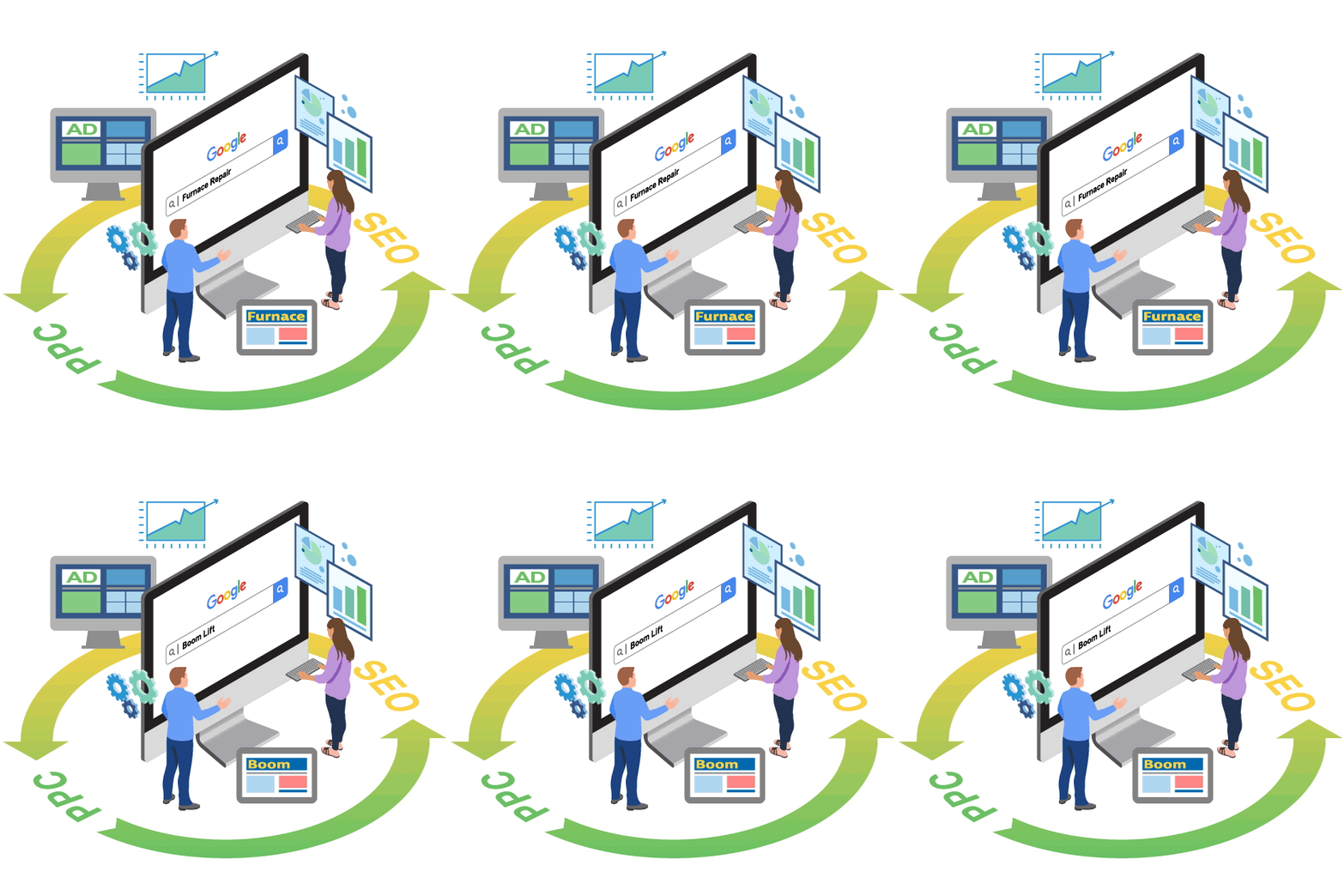
 What Search Can – and Can’t – Do
Our friends at Enquiro recently published an article making some cogent points about search.
On the one hand, it’s exciting to see search, including SEO (search engine optimization) and SEM (search engine marketing) flourishing as a marketing option. On the other, it’s alarming to see so many people jumping into an admittedly-sturdy lifeboat in a raging sea.
Rather than seeing search as a marketing channel, Enquiro suggests, we should view it as a connector, connecting interested prospects and customers with your place in cyberspace.
A similar article in Ad Age compares search to trade or in-store promotion. ---More---
|
December 8, 2008 | 11:07am
According to a study reported in the online edition of B-to-B magazine, display ads on the web have a positive impact on search activity, improving clicks for organic and paid search by 155% on average, depending on the industry.
The study by Specific Media, an online media distribution company, analyzed comScore Ad Effectiveness data over a 12-month period. While the study was largely consumer-focused, there’s no reason to believe the results would be different for b-to-b or industrial marketing.
And while not conclusive, it gives credence to the theory that online display advertising has a branding impact.
In our experience, search, both organic and paid, routinely enjoys significantly better performance than other online media, as measured by click-through rate, time on site, pages viewed, bounce rate, ---More---
|
November 21, 2008 | 3:54pm
You hear all the time about the tricks some companies employ to gain higher Google rankings: link farms, white text, and so on. But it’s clear that the bright folks at Google are working overtime those who are trying to beat the system.
Some people thus criticize Google for the influence (some might say, “control”) the Googleplex exercises over what happens on the Internet.
I, on the other hand, believe they have made a major contribution in one very important regard. Because of their unswerving dedication to the accuracy and success of a user’s search, they have forced marketers to pay attention to content.
They’ve made search engine optimization a very simple proposition: content is the one “trick” that will always work. And, because it can stay on your site forever (or at least until it’s overtaken by new developments), content is the gift that keeps on giving. ---More---
|
November 7, 2008 | 1:29pm
 How many "Top Ten Tips" columns have you read lately, looking for a sure-fire solution for better marketing in difficult times? Are you getting a little jaded? There's the SEO or SEM expert who says you need to spend more of your reduced budget on (what else?) search. The direct mail company that says direct is the way to spend your way out of recession. The social media guru who says this new phenomenon is the way to success. While old-line publishers say it's time to get back in touch with print!
I guess it's true: if the only tool you have is a hammer, every problem looks like a nail.
There is no "one size fits all" in this environment...or any other. You need to understand how a difficult economic environment may change overall business strategy, and then make sure your marketing communications strategy is appropriately revised and aligned. Then you can revisit your budget and invest in the activities that best support the strategy. ---More---
|
October 28, 2008 | 5:00pm
The word you has always been one of the magic words in advertising and marketing and it’s one of the ten magic words in direct marketing. As long as it’s not demanding or confrontational (“Uncle Sam wants YOU!”), the use of the second person is inviting and friendly. Conversational, or better yet, engaging.
The new interactive media have taken that you imperative to a new level, kicking classic marketing engagement into a higher gear. With interactive marketing, we not only have to say we want you, we have to prove it. Thinking of how you might search for our product. Thinking of what information you need to know on a web page. Providing the information you need to make intelligent decisions, including direct product-to-product comparisons. Making offers that are relevant and meaningful.
That means nurturing you. Enticing you. Winning you over. Or you simply don’t take the actions we want. ---More---
|
September 25, 2008 | 10:14am
The Path to Retention (Lynne Marie DeMers-Hunt)
Today’s customers in the B2B market are increasingly savvy and have high expectations. They will not tolerate negative experiences or inconsistencies across channels. Successful B2B marketers need to understand that it's no longer about simply pushing the products they produce, but also outwardly addressing their customer’s needs at the center of the buying experience. So how do you “pull” instead of “push”? You need to understand and capture the customer’s needs and preferences – valid research and utilizing a hyper-integrated method of marketing throughout the buying cycle is a must. The customer’s experience must be optimized for the specific need at that specific moment, on their progression toward purchase. B2B marketers need to listen, gather feedback, and adjust to each changing phase. ---More---
|
July 23, 2008 | 8:54am
What is creativity? I would love to hear everyone's opinions on creativity and what you feel is creative from a B-to-B perspective? Wikipedia's definition: " Creativity (or "creativeness") is a mental process involving the generation of new ideas or concepts, or new associations of the creative mind between existing ideas or concepts." I believe that what is highly creative starts with a big idea--which encompasses a simple powerful message, well written, a powerful image (if applicable), is memorable, has a strong call to action, and allows the end user to complete a thought effortlessly. The big idea -- when integrated across the traditional and 2.0 landscape, with the ability to attract attention, interact, and engage an audience where they live, in a program -- is so exciting. ---More---
|
June 30, 2008 | 11:04am
The revolution in how people use media has ignited the upheaval in marketing communications strategy we are calling hyperintegration. It begins with media, but doesn’t end there. Time was, the job of media professionals was to make the best purchase among a limited number of advertising media. In the consumer world, that meant TV, magazines, newspapers, and radio. Maybe outdoor. In business-to-business, the range was even tighter: which trade journals fit the best and were the most cost-effective? The explosive growth not only in the number of options, but in their essential nature has changed the situation dramatically. A podcast offers informal, but personal, contact. A video shows rather than tells. A webcast demonstrates expertise. And it’s hard to beat search – paid or organic – for generating leads. The point is, it’s not just about reach and frequency any more. ---More---



|
June 23, 2008 | 2:54pm
We recently had a discussion with a vendor who, in the process of extolling his web analytics product, said his company’s technology went beyond clicks and conversions. That ended up being troublesome for two reasons: First, we’d be happy with reliable information on clicks and conversions, thank you. We’re not convinced we’re getting it from some of our existing resources. So we weren’t about to let a sales guy get away with changing the subject because he didn’t want to address our concerns. And second, he offered a solution that was even worse. His company’s megabucks solution, engagement mapping, would track the activity of individual site visitors and try to give appropriate “credit” to other media, like online ads that a visitor may have seen, instead of just the last click. That’s trying way too hard. It’s building a technology solution to a marketing question. ---More---
|